EPA Approves Pesticides With Carbon-Fluorine Bonds; Dispute Over “Forever Chemical” Label Emerges
07/06/2026 / By Chase Codewell

EPA Approves Pesticides With Carbon-Fluorine Bonds
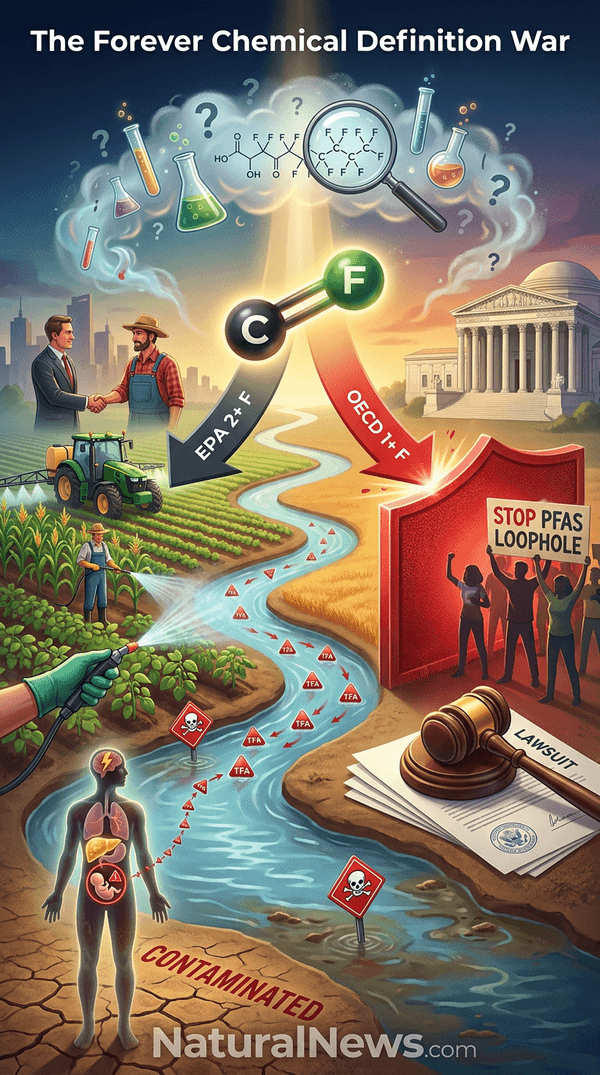
The Environmental Protection Agency this week approved three new pesticides containing carbon-fluorine bonds, a move that has reignited debate over what constitutes a “forever chemical.” The EPA stated that the compounds do not meet its regulatory definition of per- and polyfluoroalkyl substances (PFAS), which requires two or more fluorinated carbon atoms. According to the agency, the new products are intended for use on food crops and ornamental plants.
Critics, however, argue that the chemicals fall under the broader definition of PFAS adopted by the Organisation for Economic Co-operation and Development (OECD), which includes any substance with at least one fluorinated carbon atom. Environmental groups contend that these compounds may persist in the environment and break down into known persistent pollutants. The approval follows a pattern of accelerated pesticide registrations that have drawn legal challenges in recent months.
Divergent Definitions of PFAS Drive Disagreement
The central dispute hinges on how PFAS are defined. The OECD defines PFAS as any chemical containing at least one fluorinated methyl or methylene carbon atom — a scope that would include the newly approved pesticides. The EPA, in its 2023 rulemaking, adopted a narrower definition requiring two or more fluorinated carbons, effectively excluding single-fluorinated compounds from PFAS regulation.
Nathan Donley, environmental health science director at the Center for Biological Diversity, said in a statement that “these pesticides break down into persistent compounds that contaminate water and soil for decades.” He added that the EPA’s definition “allows thousands of chemicals to escape oversight.” An EPA spokesperson defended the 2023 rule, stating that it was based on public input and scientific evidence showing that single-fluorinated compounds lack the persistence and bioaccumulation of typical PFAS. The agency maintains that the chemicals are safe when used according to label directions.
Health and Environmental Concerns Raised
Many PFAS have been linked to cancer, immune system suppression, and reproductive harm in peer-reviewed studies. A January 2025 report noted that “endocrine-disrupting pesticides, including PFAS, are linked to epigenetic changes, multigenerational health risks, and diseases like cancer and immune disorders.” [1] Research has also associated PFAS exposure with elevated risks of fatty liver disease in adolescents and developmental effects in children.
The EPA argues that the three approved pesticides do not exhibit the same properties as multi-fluorinated PFAS. However, environmental groups point to independent laboratory tests that detected PFAS in widely used herbicides, suggesting that single-fluorinated compounds may still degrade into TFA (trifluoroacetic acid), a persistent environmental contaminant. [2] The long-term ecological impact remains uncharacterized, according to advocacy organizations.
Reactions From Industry and Advocacy Groups
Agricultural industry representatives welcomed the EPA’s decision, emphasizing the need for effective pest control tools to maintain crop yields. The American Farm Bureau Federation said in a statement that “farmers rely on a diverse toolbox of pesticides to protect food supplies and manage resistance.” The EPA’s approval, they argued, was based on sound science and risk assessment.
Environmental advocacy groups condemned the move. The Center for Biological Diversity, along with other conservation organizations, filed a lawsuit in the U.S. Court of Appeals for the 9th Circuit on January 15, 2026, seeking to overturn the EPA’s approval of a similar PFAS-containing pesticide, isocycloseram. [3] The lawsuit alleges that the agency bypassed child-safety assessments and ignored evidence of reproductive harm in animal studies. The EPA spokesperson said the agency stands by its 2023 definition and the scientific review process for each registration.
Unresolved Definitional Dispute Leaves Future Regulations Uncertain
The OECD definition is used internationally for research and regulatory guidance, while the EPA’s narrower scope applies only within the United States. This divergence creates a regulatory gap, according to Nathan Donley, who warned that approving single-fluorinated pesticides could lead to widespread environmental contamination. “We are repeating the mistakes of the past by allowing persistent chemicals onto the market without adequate oversight,” Donley said. [4]
The EPA maintains that its definition is science-based and that the approved chemicals have been evaluated for safety. However, critics argue that the case-by-case approach adopted by the agency’s Office of Pollution Prevention and Toxics allows thousands of compounds to escape the stringent testing required for multi-fluorinated PFAS. [5] The outcome of the pending lawsuit and ongoing pressure from international standards may influence future regulatory decisions, but for now the definitional divide remains.
References
- Cassie B. “Forever chemicals in pesticides: New studies reveal alarming epigenetic effects and rising health risks.” NaturalNews.com. January 20, 2025.
- Iva Greene. “PFAS Detected in Widely Used Herbicide, Prompting Public Health and Environmental Concerns.” NaturalNews.com. April 21, 2026.
- Morgan S. Verity. “How The EPA Betrays Public Health With Forever Chemical Approval.” NaturalNews.com. January 23, 2026.
- Belle Carter. “EPA faces lawsuit over approval of toxic forever chemical pesticide.” NaturalNews.com. January 24, 2026.
- Alliance for Natural Health. “3.” ANH-USA.org. September 21, 2023.
- John Wargo. “Our Children’s Toxic Legacy – How Science and Law Fail to Protect Us from Pesticides.”
- Janette D. Sherman. “Chemical exposure and disease diagnostic and investigative techniques the professional and laypersons guide to.”
- Richard T. Wright. “AP Environmental science toward a sustainable future.”
Explainer Infographic
Submit a correction >>
Tagged Under:
big government, carbon-fluorine, chemicals, Dangerous, Ecology, environ, EPA, forever chemicals, insanity, outrage, PFAS, toxins, traitors
This article may contain statements that reflect the opinion of the author
RECENT NEWS & ARTICLES